Saturday, August 10, 2013

The Arno River and the Basilica of Sana Croce

Puppet show on the side of the street!
       We left the Piazza della Signoria and followed Bianca toward the Arno River.  When we arrived at the river, it was relatively calm as  people sculled on long boats down the river.  Historically, the Arno River has expanded due to heavy rains and has flooded the cities in its path causing great havoc. The river originates in Mt. Falterona in the Appennines Alps following a western flow near Arezzo passing through Florence, Empoli and Pisa entering into the Tyrrhenian Sea at Marina de Pisa.  Two dams were built that have prevented yearly flooding.  But in 1966 there was so much rain that the dams were about to burst, more water was let out causing so much flooding that in Florence alone 40 people died and countless works of art and rare books were distroyed. If it wasn't for people around the world donating money for restoration, much of the art work would have been lost.
Waiting by the Arno River
water line in the flood of 1966
Bianca pointed to the Ponte Vecchio Bridge and brought our attention to the little windows that bordered the top of the building.  This was the extension of Vasari Corridor that was built for Cosimo I so he could walk from the Uffizi (the office) to the Pitti Palace across the Arno River.

Ponte Vecchio


       We then followed Bianca through some narrow streets to our restaurant near the Pazza Santa Croce. As we turned the corner, we noticed a puppet show taking place.  We stood for a few minutes and found only one old guy handling all the puppets. He had them dancing to recorded music. It was hilarious!  Bianca just kept on moving like this was something you see every day, and we had to run to catch up to her!
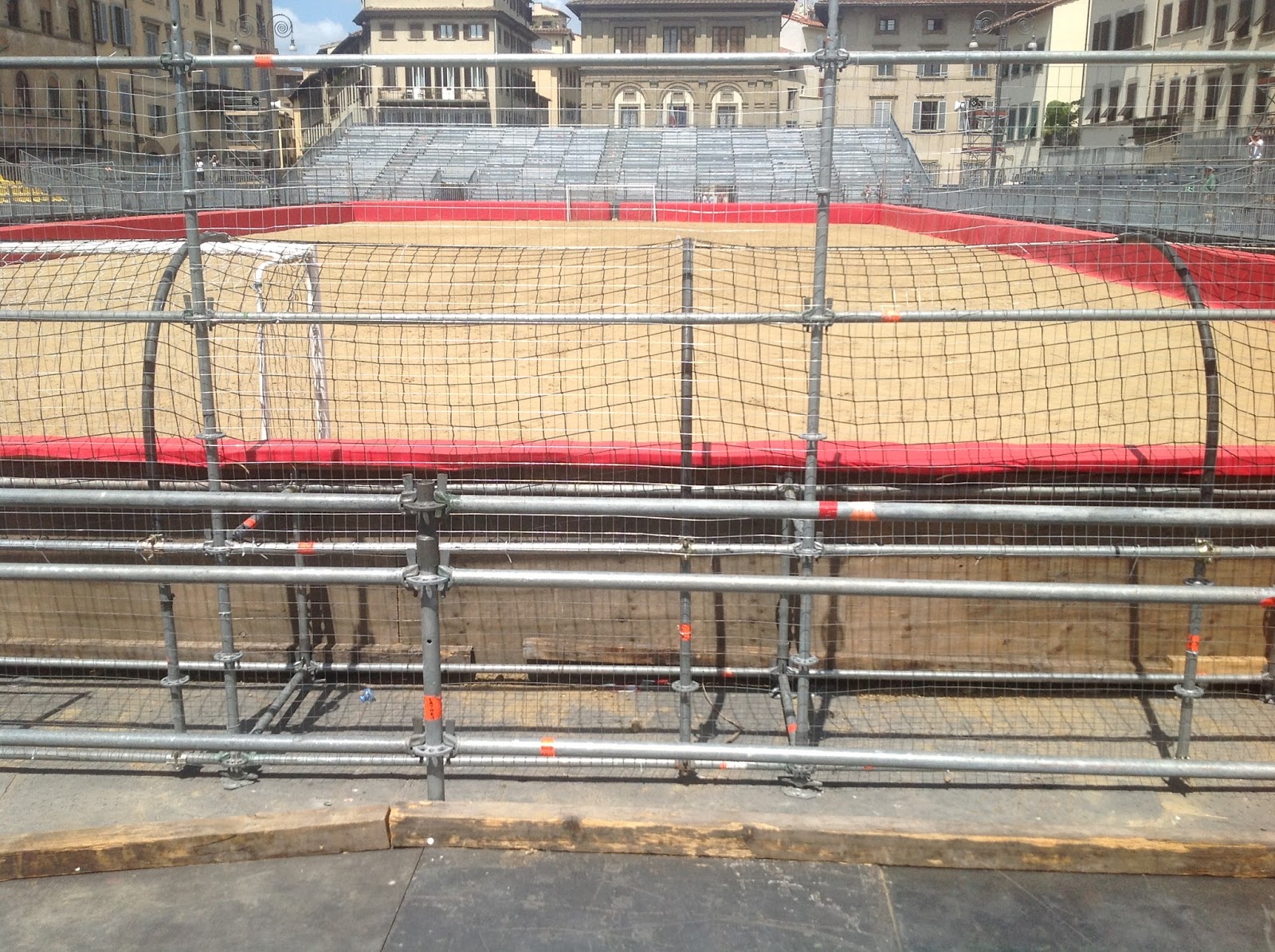
       We arrived at the square that was made into a soccer stadium ready for the San Giovani soccer tourament the following weekend.  There were portable bleachers all around and the playing filed was filled with sand like a colleseum.  I guess with the rules they have for the game, they will see lots of blood and guts as the players go all out for their team.  I wonder if they have referees??
We could all imagine the hoopla during this festival!  They will end it with fireworks late at night!
    
       Bianca then led us to the front of the Basilica of Sana Croce (Basilica of the Holy Cross).
Front Door

Note the Star of David as part of the facade.
       This is the largest Franciscan church in the world.  Legend has it that St Francis founded his church on this site and then it was rebuilt to this size and consecrated in 1442 by Pope Eugene IV. The church is simplistic recognizing the teachings of St Francis.  The Neo-Gothic marble facade was destigned by Nicolo Matas in 1863.  He worked the Star of David into the composition at the top.  Matas wanted to be buried with his peers in the church,  but because he was Jewish, he was buried under the porch and not within the walls.  The Museo dell'Opera di Santa Croce is housed in the refectory.  Florence Nightingale was born in Florence which gave her her name.  There is a monument for her that stands in the cloister of the church.  In 1966, the Arno River flooded much of Florence, including Santa Croce. The water entered the church bringing mud, pollution and heating oil. The damage to buildings and art treasures was severe, taking several decades to repair.
     We had time to enter the church and see some of the famous tombs that were housed in the church.
 Tomb of Galileo
Tomb of Michelangelo
Mass was still going on so we were not able to go through the complete church and see the other tombs.
We quietly left and headed down one of the side streets.
Then we rounded another corner to find other shops.

Elvis was here!

Everything looked good!
Then we came to our restaurant...
We entered and were seated in the large room reserved for our group by the tour company.
John is ready to taste the wine while Francesca asks us what would like to eat!
     We had a wonderful lunch of salad and pasta lots of wine and fresh baked bread brought out in a paper bag.  We sat with people from the Ohio who were also enjoying themselves.  John did the honors with a fine Chianti wine from the Gaiole vineyards in Tuscany.  We kept our eye on the the clock and after we each had two glasses of wine and ate most of our meal, we told our surprised friends that we had to leave to go to the Uffizi Gallery.  Francesca drew us a little map to go back to the Uffizi near the Piazza della Signoria so we would not get lost.  We would be returning back to the Piazza Santa Croce to catch the bus at 4:00.  She wished us good luck, and we were off by ourselves to the Uffizi Gallery!


Wednesday, August 7, 2013

La Piazza della Signoria


 Our lollipop girl started her walk down the street, and we followed along to the Piazza della Signoria the political part of Florence.  We came upon castle looking fortress on the far end of the square. This became the seat of government when Cosimo I moved in in 1540.  It is now a museum.
Palazzo Vecchio now a gallery and where the city mayor conducts business.
       When we think of the Italian Renaissance, we often think about the Medici era in Florence. The Florence Republic prided themselves as being democratic and secular although the Medici family tended to manipulate things.  They were into banking and textile trade.  The Medici Bank became one of the most prosperous in Europe expanding from Italy to other countries.  This political dynasty lasted from the 1400 thorough the 1500 fostering art and humanism.  They backed many guilds that flourished in the city.  Their textile guild was the Arte della Lana(wool).  This Palazzo Vecchio was the political center in the early part of the 1400 until the palace was moved to the Pitti Palace across the Arno River.
     The Medicis were also involved with the Catholic Church.  It is important to note that the renaissance movement was not against religion but many felt that man was given powers by God that expected man to use his intellect and body to solve problems instead of just prayer alone here on earth.  Just to be on the safe side though the Medici family became involved with the powerful Catholic Church.   The Medicis produced four Popes: Pope Leo X (1513-1521), Pope Clement VII (1523-1534), Pope Pius IV (1559-1565), and Pope Leo XI (1605.)
     Being in with the Popes also helped them in their textile industry.  There was a discovery of the substance known as alum in Tolfa, Italy.  Alum is essential in the dyeing of certain cloths and was used extensively in Florence where the main industry was textile manufacturing.  Up to this time the Turks were the only exporters of alum, so Europe was forced to buy from them until the discovery of alum in Italy.  Pope Pius II granted the Medici family a monopoly on the mining rights there, making them the primary producers of Alum.
       Another area they extended their influence was in setting themselves up as royalty and marrying into other royal families in Europe.  They were connected to Spain through he marriage of Cosimo I to Elenore of Toledo.  By marrying Catherine de Medici to the son for Francis I of France they got influence in the French Empire. Furthermore,Mary Medici daughter of Cosimo's son Francesco became queen of France.  Thus the line of the Medici family progressed through every succeeding French monarch.
Cosimo I of the Medici family
   Arriving at the square, Bianca told us about the history of the Medici family and about the sculptures in the square.
Bianca giving us a history lesson!

  We looked out to the square and our direction went to the man on the horse.  This is Cosimo I.
Cosimo I
         To the side of the plaza is the Neptune Fountain commissioned for the wedding of Francesco 1 de Medici and grand Duchess Johanna of Austria in 1565.  This marriage was not a happy one as told in the novel, Bianca by Robert Elegant and the history of this fountain seems to attest to this fact.  It has seen a lot of damage through the years.  In 1580 it was used a a wash basin.  At the end of the century one of the satyrs was stolen during the Carnival.  In 1848 it was bombed by the Bourbons of Spain. After its restoration in 1982 it was painted blue after a win by Florence's Soccer team. in 2005 a drunk man climbed and slipped and broke off one of the hands.
Across the square Bianca showed us a covered building with lots of statues.

 This was formerly a rostrum where citizens could stand on a box and give their opinions.  Later when the Medici figured that displaying good art was more important than free speech, they changed  this Loggia into an outside display area.  The chosen sculptures depict the Florentine themes: Conquest through intellect and Dominance.

Perseus holding the head of Medusa by Benvenuto Cellini

        First we have Perseus holding the severed head of Medusa.  Using his wits, he tricks Medusa by looking at his shield until she is close to him, then closing his eyes he turns and severs her head from her body.  If he had looked at her ugly head directly, he would have turned to stone.  So he used his brain to trick her.

        Then we have Giambologna's Rape of the Sabine women. Tells the story of early Rome when the Romans needed females to mate in order to prolong their race.  They invaded a near by village and stole their women.  In this statue Giambologna shows the intertwined bodies using one piece of marble. He depicts the last desperate view of the wife as she twists to see her husband before she is taken by the stronger Roman.  As you walk around this statue, it is even more alive as you see the straining muscles and the force of the rape.  This is a truly amazing sculpture displaying profound emotion.

Rape of the Sabine Women

To the left of the Loggia, two statues flank the entrance of the Pallazo Vecchio.

Entrance to the Palazzo Vecchio
 The one on the tight is a sculpture of Hercules and Cacus by Baccio Bandenelli. It depicts the demi-god Hercules, who killed the fire-belching monster Cacus during his tenth labor for stealing cattle.  It shows a symbol of physical strength.  It is balanced by the other statue,  The David which shows spiritual strength.  Both  show the symbols desired by the Medici dynasty: the victor (Medici) vanquishing the republican enemies.  The "fake" David is across on the other side of the entrance.  The "Real" David is in the Accademia Gallery placed there for protection from vandals and weather elements.
Hercules and Cacus
 To tower was placed where a previous one was erected on a previous building.  That is why it is not centered on this building. The tower has a prison that once held Savonarola, the rebellious monk.  The clock by Vincenzo Viviani was placed on the tower in 1667.  Below the crenellated battlement are painted nine coats of arms of the Florentine republic.  The tower was used as a lookout tower and the windows of the palazzo where high enough to prevent being hit by tones from angry mobs during unrest that occurred on the square form time to time.  The tower holds three bells.
Bell tower
Bianca pointed to the little attachment between the Uffizi building and the Palazzo.  This is part of the Vasari Corridor.  It happens that Cosimo I did not want to walk down to the square to get from his office in the Uffizi from his home in the palace.  So he had Giorgio Vasari his architect build a passage way between the two buildings.
Vasari Corridor between the Uffizi and the Palazzo Vecchio
Later when the Palazzo Pitti was built across the Arno River the Vasari Corridor was extended to go above the houses that lined the river and across the Ponte Vecchio Bridge to the palace.  The area where it went over the bridge used to be a butcher shop where the butcher could drop remains into the water below.  There was always a bad stink in this area so when the corridor was built, the site was replaced gold smiths.
Extension of the Vasari Corridor
I was reading the novel, Dante by Dan Brown at the time, and there is a part of the story that takes place in the Vasari Corridor.

Just as we were getting ready to leave the square, we heard the sound of drums coming down the street.  As we looked we, were thrilled to see a parade of men dressed in Renaissance clothes as they headed to the door of the Palazzo Vecchio.  They were advertising the feast of  San Giovanni on June 24 that would take place in the Piazza de Santa Croce with a Calcio Storico - a soccer game played in the square.  Calcio Storico began in the 16th century. The rules are slightly different from regular calcio or soccer. Three matches are played each year. Head-butting, punching, elbowing, and choking are all legal. A violent match, sometimes people get hurt but it never seems to dampen anyone’s enthusiasm for the game.  It all ends with grand fireworks display!

If you have ITunes, you can watch the parade!


Monday, August 5, 2013

Florence - Il Duomo and Loggia de Mercato Nuovo

 
John and the Pig!

   We followed Bianca down Via Ricasoli towards Il Duomo which is regarded as the center of town.  We could see the part of the tower and building that is distinguished by the pastel block design.
On the way we saw stylish shops with well designed leather coats.


As we got closer to the church we were amazed at the size rising to the heavens.
At the end of the street we see the church facade in red, while and green marble set in rectangular patterns all the way up to the top of the church.
Looking to the side we see the famous dome.
         Il Duomo is the Basilica di Santa Maria del Fiore the main church of Florence. It is an enormous building: length -502 ft, width 124 ft. heighth of the dome 377 feet. The Cathedral includes the Baptistery of St John and the Campanile built by Giotto di Bondone. Il Duomo was built in 1296 designed n a Gothic style by Arnolfo di Cambio. It was finished in 1436 when Filippo Brunellescdhi erected the dome.  The dome was the largest dome of its time. Brunelleschi studied the dome in the Pantheon in Rome and mathematically designed the first 'octagonal' dome.  He used a dome inside a dome design to make it a free standing dome without flying buttresses for support. First he built the white ribs that arch the dome from the base to the point on top, then he added the bricks in a herringbone pattern between the ribs to transfer the weight of the freshly laid bricks to the nearest vertical ribs of the non-circular dome. On top he placed the lantern securing the ribs and topped it with a the cross.  Originally this is where the statue of the David would have been, but the weight of the statue prevented its elevation to this height. This dome was the an architectural wonder and the model for many domes to come even to our dome in the U.S Capitol.
      The facade underwent a history of "too many hands in the pie" as six different architects tried to assemble a unifying pattern that could not be finished.  Finally in 1588 it was disassembled and left that way until the 19th century when it was rushed to completion in 1887 by Emilio de Fabris to comemoprate the unification of Italy. It is made with polychrome marble panels applied to make it look like a painted design. The walls were faced in alternate vertical and horizontal bands of marble from Carrrara (white), Prat(green), and Siena (red).  The bands were made harmonious to those in the Baptistery and the Bell Tower. 
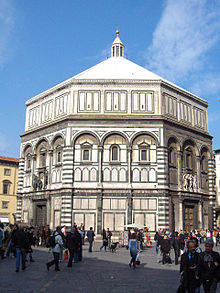
     The adjoining building is the Baptistery of St. John. It is the oldest building in the city built around 1057.  The architecture is in the Florentine Romanesque style with inlaid tiles of colored marble.  The number eight has a special significance to the Christian faith which is the reason most baptisteries are built in the octagonal shape.  It signifies the six days of creation, and one day of rest, and a day for re-creation through the Sacrament of Baptism. This was the fount where all Florentines were baptised.

     The Baptistery is also known for its doors.  In1401 a competition was proclaimed by the "Cloth Importers Guild" to design doors which could be placed on the east side of the baptistery.  These doors would serve as an offering to celebrate the survivors of the Black Death.  The commission was won by a goldsmith Lorenzo Ghiberti.  The east doors were to depict the story of Joseph from the old testament, kind of like the "Joseph's Multicolor Dream Coat" only the story would be  told in ten panels forming the door.   Ghiberti employed the use of perspective space using different sculptural techniques from incised lines to almost free-standing figure sculpture accentuating a sense of depth.  The framework was detailed decorative foliage, fruit, and statues of prophets.  Michelangelo  named these doors as the "Gates of Paradise"  for their beauty and realism.

Gates of Paradise
Three dimensional panel showed the use of perspective depicting the new Renaissance technique.
Bianca then lead us to the Bell Tower known as Giotto's Campanile. The building of the tower was begun with Giotto de Bondone but he died before it was finished.  Then his plans were completed by Adrea Pisano and Francesco Talenti.  This is a showpiece of Florentine Gothic architecture decorated in ploychrome marble pannels.  It stands 47.41 square ft and 278 feet high.  This slender symmetrical tower has five levels.  The lower two levels are most intrically decorated and are a joy to feast your eyes on all that is placed there, though you might end up with a sore neck!
     THe lower story features hexagonal panels and reliefs set in diamond shaped "lozenges"  which show the Creation of man, the planets, virtues, liberal arts, and the sacraments. The second level is decorated with two rows of niches in which there are statues of profits from the bible.The third level and fourth level  have eight windows all around and the fifth level has four tall windows.  The top story holds seven bells and a viewing platform. There are 414 steps to go to the top and there is no elevator.  John and I were game to run up the stairs to get a good view of Florence but Bianca said we had other places to go.  You really need more than one day to see all there is to see in Florence!

John walking to see the tower.

Lower levels
Full tower!
We looked around and spotted Bianca with the Number 1 lollipop just as she entered Via Calziuoli the main street of Florence.  We caught up to her and looked down the row of trendy stores.
We continued following her past Via dell Oche.
Soon we could see a large arch.This the is Arch of the Republica.  It is right here where two main Roman roads intersected here and a pillar was placed on this spot that  is comically called, "the belly button of Florence!"
Walking closer to the Arch, I noticed a street called, Via De Medeci!
The Arch and the square were built around 1870  to celebrate the Unification of Italy.  Before the unification, Italy existed as separate city states such as Florence and Venice loosely influenced by Rome through the Catholic Church.  America was united in 1776 so we had a few years on Italy!

The Republic Square
We continued walking down Via Calimala bipassing the Orsan Michele Church and the Bargello Museum and headed to the Mercado Nuovo.

We were really in the ritzy area of town now!

Soon we came upon the Loggio de Mercato Nuovo which is a covered market place.  It is sometimes referred to as the Loggia del Porcellino.  It was built around the 16th century intended for sale of silk fabric and luxury goods.  Now mainly leather goods and souvenirs are sold to tourists. Our guides stood around and waited for us to buy stuff but none of us did.  We just enjoyed a little window shopping.
Loggia del Mercato Nuovo
Handbags sold by Iranians from South American leather.
The focal point in the loggia is the Fontana del Porcellino which means the "Fountain of the Piglet."  This is a copy of the real fountain that is now at the Palazzo Pitti across the Arno River.    The story goes that if visitors place a coin in the mouth of the boar after rubbing its nose, and if the coin goes down into the fountain, the person will have good fortune. Since this pig is not in a fountain, they have installed grates where you can place your money.  This might be the beginning of piggie banks!

Pay the Pig!
John wants good fortune!