|
| Cameos made from conch shells |
We made our way along the "Blue Highway" on the way to Pompeii. We then circled back to the Naples coast to the town of Torre de Greco where we stopped for a restroom break before making our hike into Pompei. Terre de Greco happens to be where beautiful cameos are made out of sea shells. The lovely studio was well equipped with bathroom facilities down below near the display cases of cameo jewelry. The designer had his studio upstairs near the entrance, and we could watch him as he chisseled into the conch shell creating beautiful figures.
 |
| Artist at work |
 |
| A finished product |
Window shopping was fun, and some from our group actually bought a few broaches. We decided to hold off since the Euro was $1.30 to our dollar! I know Queen Victoria would have loved some of the broaches on display!
We then were led down the street to a few more shops an a store where they gave free samples of
limoncello, a liquor drink with lots of vodka and sugar. We were all eager to try some samples, but Angelina stopped us half way across the entrance door and said we would have to wait until we got back from our walk through the ruins. She said there was a good chance we would not make it back if we had
limoncello to drink! So she reminded us about just drinking water for now.
 |
| Angelina giving directions |
Angelina gave us our ear phones and told us that since it was petty hot day, she would make sure that we would stay in the shade through most of our walk. She was eager to tell us all bout the ruins of Pompeii. "Come along, my family, and follow the number 10 lollipop and stay together!"
Pompeii was founded around the seventh century BC. By the first century there were approximately 20 thousand people living in the port town. The city was a popular vacation spot for rich Romans who may have had vacation homes in the area. It had a prosperous port, amphitheater, gymnasium, spas, and a complex water system so it showed the good life of ancient Rome. Earth quakes were common in the area and some did damage ten years prior to the volcanic eruption. The people did not seem to make the connection with the danger that loomed ahead. They didn't even have a name for VOLCANO! So when Mt. Vesuvius blew her top in 79 AD sending a plume of smoke high in the air, the people of Pompeii had no idea the danger that was to come.
When ash started to fall around the city, they thought they would be sheltered in their homes. The ash was so thick it blocked out the mid day sun which must have added to the fear. As Vesuvius spewed light pumice, stones, deadly gas and ash some tried to get away and went to the dock and wait for out going wind. Later in the afternoon, large rocks began falling a down on the roofs that could not hold up the accumulated weight and houses started caving in. Vesuvius continues to rumble and then thermonuclear explosions 100 thousand times more than Hiroshima sent pyroclastic flows first toward Herculaneum and then as the winds changed the hydrothermal pyroclastic flows swooped down on Pompeii. 16,000 people died instantly throughout the whole city. Vesuvius continued to erupt for two days covering everything so thoroughly that when a Roman rescue expedition finally was able to come, nothing could be found except a huge mound where the town had been. It sat undiscovered for 1600 years.
Angela asked us why no one excavated the city before. We all guessed: Didn't have the money! Didn't have the tools! Sacred ground should not be touched! No, No, No....."The answer is that no one cared!" The fall of the Roman Empire was occurring and the new wave of Visigoths, and other invading groups never knew the hidden town was there. She continued, "It wasn't until 1599 while digging and under ground channel to divert the Sarno river that the work men came upon a wall covered with paintings. An architect by the name of Dominico Fontana unearth a few more frescoes dealing with human fertility, and that was it. The sexual content of the frescoes was cause enough to have them censored and in some cases reburied!
The town of Herculaneum near by, was rediscovered in 1738 by workmen digging the foundation for the palace for Charles of Bourbon the King of Naples. Ten years later Pompeii was rediscovered in 1748 by the Spanish military engineer Rocque Joaquin de Alcubierre. When Charles of Bourbon became the king of Spain, he took great interest in the antiquities as it reinforced the political and cultural power of Naples. For the next hundred years excavations continued even through the French occupation under Napoleon.
 |
| Angelina explains about the main street of town. |
We followed Angelina up the main street of the town. All the streets were in the Roman style of grid set in straight lines with 45 degree intersections. They were all labeled with the names on the corners. The streets were paved with large stones, recessed below the sidewalks. Rain water would flow down these streets as natural drainage keeping everything clean. When people wanted to cross the streets they would walk over the large stones. These stones were set far enough apart so that the chariots would be able to straddle them when they used the road.
Angela pointed with her lollipop to areas that were closed off to tourists because excavations where still taking place.
 |
| Reinforcing the roof |
 |
| All the streets are clearly marked with names. |
We could also see where restoration of buildings was continually taking place. For 1600 years while everything was covered and no air or moisture could get into the structures, and because of this they were preserved. Now that they are opened to the element these ancient walls are disintegrating. In 2010 the gladiator's quarters simply collapsed due to moisture from the rain. Italy is concerned about this because Pompeii is an important tourist attraction. The government is actively raising money for renovations to ensure the city for future generations.
We continued following Angela's lollipop along the main street, meeting many other tourist.
The side streets off the main one were much smaller and we followed up the hill watching where we were walking among the cobble stones and still keeping an eye on lollipop #10.
We gathered at the top and waited for the rest of our group.
As we reached the flat area, Angela pointed out some tall columns that were the remains of an aqueduct system that brought water to the town. Excavators also found and extensive water system using iron pipes underground that would supply water to homes.
 |
| Columns of what is left of an ancient aqueduct system |
 |
| metal pipe system |
 |
| single pipe in another part of the city |
Soon we walked into an open area that would have been the market square. This large open area would be filled with tables where merchants would sell their wares.
 |
| Market space |
 |
| Market shops |
Next Angela took us to see the Roman baths. The Roman culture idolized the human body and working out to build muscles was a must in that culture for men and women. They wanted to be like their gods showing strength and beauty. After a workout in the gymnasium, the people would go to the bath. There were several in the city and there was one for women as well. We went to see the most outstanding one in the city which was a "MEN'S CLUB" for the wealthy men of the city.
 |
| Entrance to the Spa! No dogs allowed then ...I am sure! |
Fist the men would go to a dressing room before entering the bath.
 |
| Only rich Romans permitted... showing their muscles in the buff! |
The water system was amazing in these rooms. The water would be pipes below the surface of the floor from large vats that were heated by slaves. The hot water would be sent through the iron pipes warming up the floor. Some would be spilled out to form sand steam that came out of the holes in the side. Then the water would spill into hot baths beyond. The men would go into the bath and soak their tired muscles.
 |
| Sauna Entrance |
 |
| Decorative ceiling |
 |
| Artist rendering of decoration |
 |
| The Bath was lit by a sky light above. |
Not to be out done, the women also had a Spa though not as luxurious.
 |
| Entrance to woman's bath |
 |
| Woman's bath with sky light! |
We then left to find some of the homes of the rich and famous.... There were several homes of the wealthy but we were only able to see one sample. Most of these villas sat behind locked, steel gates. When they were first discovered, the expensive artifacts were taken and placed in the Naples Museum so they would not be stolen. Many of the frescoes were taken down and also placed in the museum so they would not be vandalized.
 |
| Private Villa |
We entered the home of a rich citizen through the atrium that is lit with a sky light.
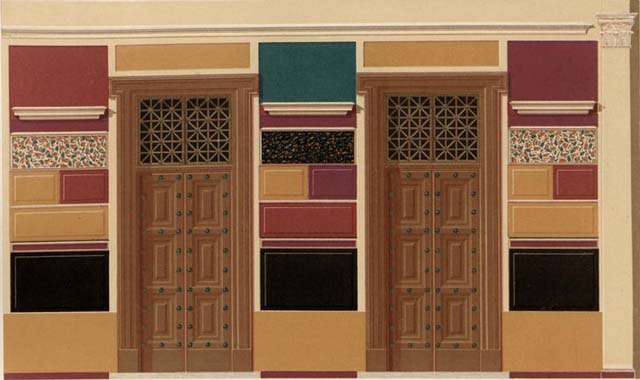
This would shine down on a pool of collected rainwater. The entrance was decorated with walls of painted frescoes.
 |
| Artist rendering of entrance |
 |
| Actaeon being eaten by dogs for having surprised Diana (Artemis) in her bath. |
Many of the frescoes depicted scenes of the gods in heroic legends. Since the body was seen in the nude, they were found to be scandalous by the medieval thinking public. Some were reburied for this reason and some were taken to the back room of the Museum of Naples and could only be seen with permission,
As we walked farther in we saw more samples of frescoes that added color to the room.
 |
| Wall as it looks today! |
 |
| Artist reconstruction |
In excavating these villas it was found that some had doors that could open and close like an accordion or fan. They found a way to make hinges that would not make any noise upon opening and closing.
Angelina explained that the servants slept up stairs or in the back of the homes. Also much of the cooking was done on outside ovens and brought into the dining hall. This arrangement would keep the house cool without air conditioning!
We then followed Angelina to the museum room where some of the body forms were kept. Angelina explained that it wasn't until Guiseppe Fiodrelli took charge of the excavation in 1863 that they were able to locate human remains in the homes. While they were unearthing the houses he found void spaces that had human remains. He devised a technique by which he injected plaster into these voids that would recreate the forms of the bodies when they died. Since excavation is still going on today, the current the method is to use resin as it is more durable and it does not destroy the bones.
We walked into the room and saw the plaster figures in glass cases showing the anguish they they went through in those last moments of life.
 |
| Figure of a woman |
 |
| Body in placer form |
 |
| from the Naples Museum |
We left the museum room and headed down the street to the brothel. Since this was a port town brothels would not surprise anyone in the times of the Romans. We looked for arrows on the cobblestones to show the direction to follow.
We followed them down a narrow street.
When we got in the vacinity of the entrance, Angelina took us aside and asked anyone who had children to wait with them outside as children would not be permitted inside. So a few moms stayed behind with their children while the rest of us went in.
Angelina said that the girls in the brothel were probably slaves from other countries such as Greece and probably did not speak Latin. So in order to communicate with the patrons, they merely needed to point to pictures on the walls. The rooms were small cubicles with the bed made of stone and maybe a cloth cover for a door.
Above the small rooms were a series of pictures of different positions for love making!
This was set up for big business and in that cultures it would be close to what goes on in Las Vegas today. Shock may have been the effect these pictures had on the workmen in the centuries of the excavation.
We exited the room on the other side of the street and found that the moms and children were left behind still standing where Angelina had told them to wait. So she hurried down to get them as we all regained our composure. Soon we saw the lollipop bouncing up and down in the hands of one of our rambuncious boys in the group.
We made our way to the Temple of Apollo up on higher ground.
 |
| As it looks today! |
 |
Artist rendering of what it must have looked like in ancient times.
We continues to another part of the high plateau to reach the Temple of Jupiter and the Forum. |
 |
| Temple of Jupiter with Mt. Vesuvius in the background. |
 |
| Forum pillars |
 |
| Forum on a better day |
Angelina sensed that we were dragging our feet but she wanted to show us the theater and the amphitheater where the gladiators fought.
 |
| Little Theater |
 |
| Amphitheater |
We were now ready to go down the hill and seek out the
limoncellos Angelina promised. We also had time for a
gelato. Angelina lined us up again and asked us to go under the bridge counting, "
uno, due,
tre, quattro, cinque..." and we boarded our bus. We were all tired but in good spirits when we got back to the dock. We thanked Angelina and Paolo for the great and safe field trip and waved good bye to Naples.
 |
| Leaving the dock in Naples! |
Homemade Limoncello Recipe
Ingredients
2 750 ml Vodka bottles (high quality 100 proof) 1.5 liters
17 organic lemons (ratio is 6 lemons per half liter)
3.5 cups sugar
5 cups water
Instructions
1. First Stage- Lemon Zest + Vodka
2. Wash lemons then zest the lemons and set aside. Filter the vodka (unless you bought already filtered). You can use a water filter for this. Combine zest and liquor into one gallon glass jar, screw lid on tight.
3. Second Stage- Adding Sugar
4. 45 days later, shake the zest/vodka mixture up. Make simple syrup by boiling the sugar with the water until the sugar is dissolved. Add half of the simple syrup then taste and add additional syrup to taste. (I ended up only adding half of the simple syrup and it was sweet enough for me). You can always add more sweetness as you make cocktails with the limoncello later.
5. Final Stage - Filtering
6. 45 days later, filter the liquor through a screen mesh or permanent coffee filter, then through an unbleached paper coffee filter. Sterilize the bottles you plan on storing the liquor in. Pour the lemoncello into the prepared bottles using a funnel to prevent a mess. Finally, pour yourself a drink or hop in the car to deliver some lemoncello to your closest friends.
Simple Lemoncello Cocktail Recipe
Ingredients
1 ounce of limoncello
2-3 ounces of your choice: club soda, unsweetened tea, lemonade, orange juice, cranberry juice, cherry juice
additional and complimentary liquor: whiskey, gin, campari, champagne or other sparkling wine
crushed ice
garnishes: mint, fresh berries, frozen bloeberries rosemary, basil, lemon slices, rosemary
Instructions
1. Add ice to a small sipping glass pour 1 ounce of limoncello then add your second choice of beverage. Garnish with something lovely.
Notes
Keep in mind that limoncello is already high in alcohol because it's made with vodka so, if you're adding more liquor you may want to add some sparkling water as well.