Thursday, July 11, 2013

Escape to Verona


Enjoying the quiet train ride to Verona
 Early the next morning we found out that two large cruise ships had docked in port, and all their travelers would be disembarking in Venice.  That would be about roughly six thousand people disembarking on this tiny island. No wonder Venice was sinking!  For this reason we thought we would take a train trip to Verona.  It would be better than fighting the lines to get a vaporetto.
     We got dressed and went down to a nearby deli to buy food for our trip.  As we stepped out of our hotel, we saw the flood of people schlepping their suitcases in a constant river passing before us making their way to various hotels down the narrow street.  After buying our food for the trip, we headed toward the Santa Lucia Train Station.  Going there was like a salmon swimming up stream in a torrential flood.  We dashed and dodged our way against the continuous traffic coming at us, finally making it up the stairs to the station.
   
Slow and fast trains


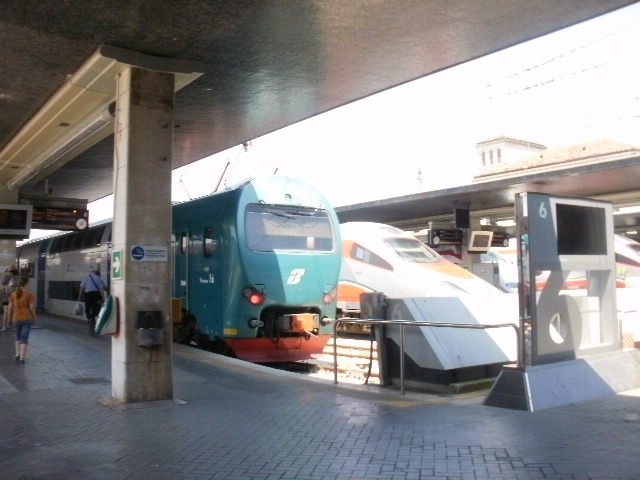
Two fast trains that have engines on both ends so they come and go without turning around!
        We looked at the log and found a slow train that was leaving in ten minutes. We managed to get two tickets and rushed to find the correct train. There were ten trains and one just began pulling out. We had just missed it as it picked up speed down the track.  So back to the station we went to change our tickets.  We were sent to another section of the station and got in line.  We told our sad story to the clerk, and he said that he would exchange our ticket to a fast train going and coming back.  It was due to leave in a half hour. It would cost 50 euros more but we were in no position to quibble.  So that was fine.  We carried our precious tickets to the waiting train and relaxed.
       When the train left the station, it was so smooth we hardly knew it was moving.  These high speed trains run on electricity with electric cables strung along overhead.  They have special rails called high speed rolling stock and dedicated high speed lines.  The advantage over planes is that the rail depots are near the center of towns and can link smaller distances than planes.  Also they are more eco friendly as they do not use gas.  I wish we had one of these to link Tampa to Orlando to Miami, and back to Tampa across Alligator Alley! This was the first time John had been on a European fast speed train.  He loved how quietly it rolled at a speed of 200 mph. We thought the slow train would give us more time to see the countryside but now on this fast train we would have an hour more in Verona.
       As we got under way the scenery changed from urbane industrial parks to open green fields of agriculture.  Lovely fields of poppies and manicured fields of vegetables were displayed as far as the eye could see.  Also there were many vineyards and tree farms with all types of decorative trees.
Bright red poppies

Agricultural field

Vineyards
     We arrived Porta Nuova station in Verona and took a local bus to get to the Piazza Bra in the center of town.  Because Verona straddles the Adige River in Northeastern Italy and is in the crossroads of many traveled roads, it has been claimed by many people in its past like a political football.  The Romans occupied it in the 300 BC and used it as a military settlement. It was taken over by the Visigoths after the fall of Rome.  The Goths claimed it until it was overthrown by the Lombards in 569.  Charlemagne crushed the Lombards and the city became the vacation sites for the rulers of Italy's city states through the Middle Ages. When Napoleon took over Italy, he made Verona part of his kingdom of Italy.  Upon his defeat, Verona was claimed as part of Austria. In the second World War it was claimed by the Nazis.  When they were defeated by the Allies, Verona was again part of Italy.
   
     We entered the Piazza and took a stroll on the Roman basalt, tile road around the lovely circular grounds with a soothing fountain in the center.  It was fun just to sit and watch people pass by speaking a variety of languages.   We saw many groups of students an well as other tourists.   The Hop on Hop off bus was stationed at one end picking people up for their tour of the city.  We had a limited amount of time, so we chose to follow our own map an head for the sites near by.


Students from the US exploring Verona
 The Arena was first on our list and it was situated across the piazza.  We walked towards it and met several interesting people along the way.

His group was from Argentina!
John though he was a Lady!
The walk way at the base of the Arena

       The Arena was built by the Romans around 30 AD. The word "arena" means sand for the sand that was placed where the fights would take place.  Its length of the building is 139 meters and 110 meters wide. It seats 25,000 people in its 44 tiers of marble seats. This was the site for gory gladiator games that were so popular that every seat was filled with the wealthy rulers in the low seats and the poor and women in the top. During the Middle Ages the Arena was used to view executions by the Inquisition and jousting tournaments.  Now Rock concerts fill the stadium. We made it a point to walk all the way up to the very top to get a good view. This wasn't easy as many of the seats were partly destroyed by centuries of people who tore up what they could for their own building needs. Also some seats were destroyed in an earthquake in the 1200s.
 
Still in use today as an ampatheater for concerts.


The stage in front is set up for the evening's Opera


     Reaching the top, we happened to meet a couple from Germany and an American theater teacher from Belmont, California who was teaching a summer course at a near by university.  We all looked down at the stage where the stage hands there were preparing for the evenings' opera by bringing huge statues supported by cranes to place on the stage.  The Opera is a big deal in Verona and people from everywhere come to the Arena to see spectacular Italian Operas such as Verdi's Aida. I made it a point to see this event on my next visit to Verona.

John points out the nice seats!
Now he points out even better seats under cover and the orchestra pit.
Large props brought down with use of cranes.
Measure the size of this prop with the people in the front.
     We left the Arena in search for Juliet.  Shakespear must have loved Verona for he set two of his plays in this local: Romeo and Juliet, Two Gentlemen of Verona.  We did some window shopping as we wen to along the narrow streets.
Two ladies from Kalamazoo

A typical narrow street with no cars.
Check out these amazing boots!

Suspended in mid-air...How do they do it???
Europeans must love worn out old Jeans! You find them in the nicest shops!
  We finally found the tunnel leading to Juliet's Balcony.
John adds his name to the list of admirers.
We arrived and joined in with other tourist admiring the statue of Juliet.
Tourists streaming in from the tunnel.
We took turns getting our picture taken with Juliet.
"Touch me here and you will return to Verona"

And me too!

Here is hoping the lovely lady will grant our wish to return again!
We made our way to the bus stop after more window shopping, and rode the bus just in time to catch our train back to Venice.  We had a most enjoyable day and could now take a siesta on the smooth train ride back dreaming of sweet Juliet...
Time to take a snooze!

Monday, July 8, 2013

Exproring Venice


Large white vaporetto on the left and canal traffic
     After a refreshing shower and a change of clothes, we stepped out to explore the Island.  We thought we would take the slow number one vaporatto all the way to St. Marks and listen to Rick Steve's rendition of the travels down the Grand Canal which is the "Main Street"of Venice. When we inquired about tickets, we found out that the number one vaporatto captains were on strike and only the faster number two boats would be running only to the Realto Bridge.  We thought of putting on Rick Steves in his chipmunk dialect to go with the faster boat, then we realized it would only go half way.  So we decided to just enjoy the ride and take pictures along the way. We knew that this part of the Canal was going to be the part with great palaces, since commercial traffic was not allowed beyond the Realto Bridge.

The Realto Bridge
 We got on the vaporatto and began the trip down the Grand Canal.  Shortly, we came on the Cannaregio Canal flowing to the left.  Following this canal you would come to the first Jewish Ghetto.  I remember this from Shakespeare's  Merchant of Venice when a curfew closed the bridge each night and no one was allowed out. This was the site of a iron foundry at one time thus getting the name, ghetto from the Italian name "geto" for iron.   Jews were permitted to live on the island after the 14th century.  They were restricted, and isolated to this island and were allowed to do business as money lenders, second-hand traders, and later as doctors and musicians. They paid heavy taxes to live in Venice.
  
 It wasn't long until a parade of palaces appeared each with its wonderful architecture blending Gothic, Baroque, and Byzantine styles. During the Middle Ages these great homes were decorated with beautiful frescoes.  Venice was pretty much a secular island.  During the Middle Ages it was so isolated that it was not affected by the church.  So life was full of fun and frivolity.  The Republic of Venice also existed outside of the Island along the coast of the Adriatic.  The economy based on trade with the Middle  East and Asia focused life more toward Constantinople.


Ca' d'Oro - example of Venetian Gothic architecture


     When we got to the bridge, we were getting hungry and found a restaurant close to where we disembarked.  We went in, ordered some beers and decided on a small pizza.  While we were waiting I sat my IPad on the table and found some Italian music I downloaded for the trip.  With in minutes everyone in the establishment was singing along with the old favorites:  O Sole Mio, Mama, Volare, Return to Sorento, and That's Amore.  Even people coming in joined the singing, and it really seemed like a party. The beer and pizza were great, and we had a great feeling of enjoying the Italian life.

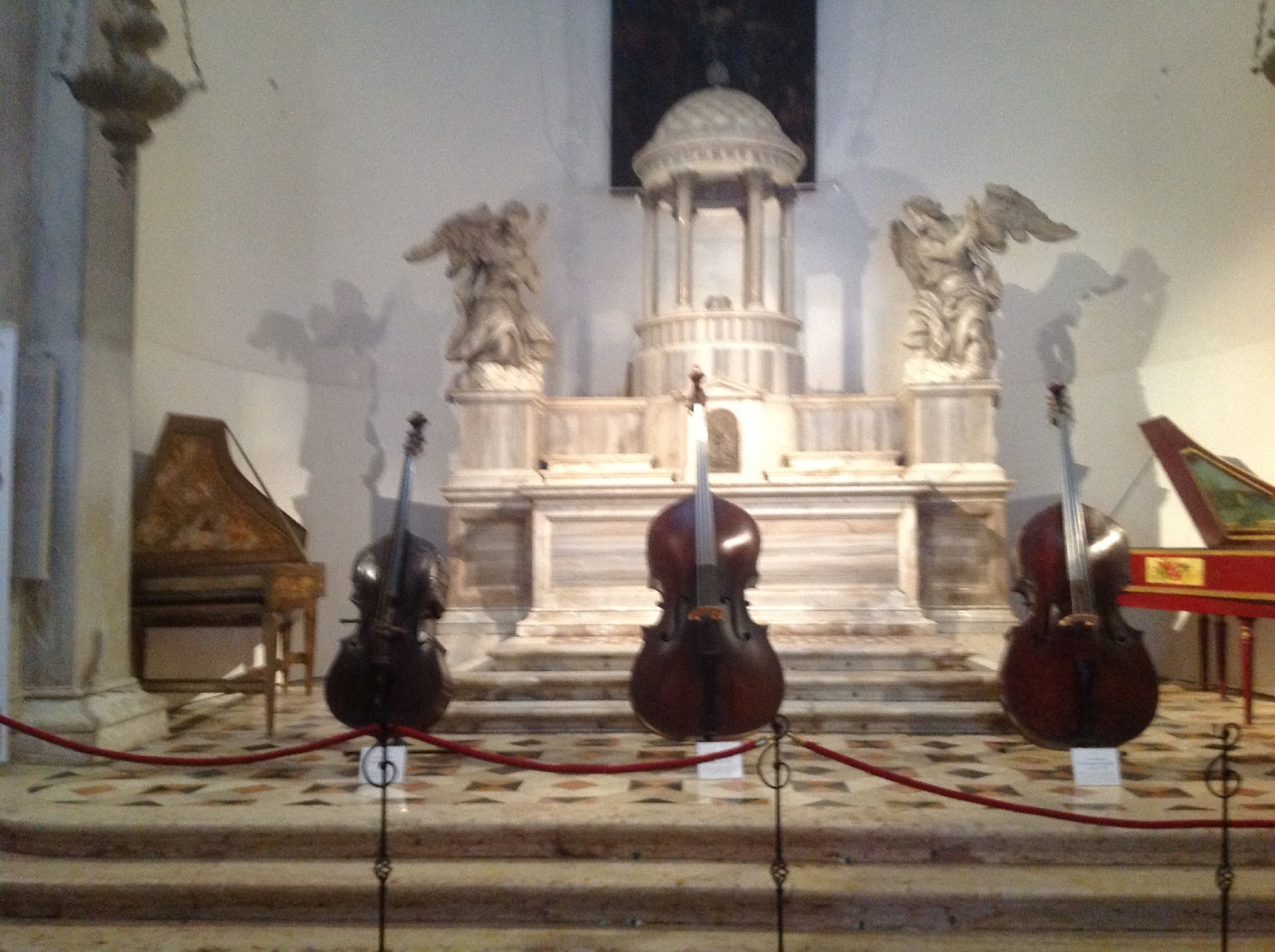
     We bade good bye to everyone and walked back to our hotel meandering through the narrow streets and doing a bit of window shopping along the way.  At one point we found ourselves in front of a small church where music by Vivaldi was playing.  We went inside and found that this church was where Vivaldi did much of his music teaching as a young priest. The Pieta as the church is called is now a museum of Vivaldi's work and exhibits of string instruments. 


John practicing for confession!


      We continued to wander the streets until we came to a canal where we considered taking a gondola ride.
The gondolier waiting for his customers.


Young Chinese couple taking a gondola ride!

We saw young couples riding in their gondola on the canal, but we would have to plan for a ride the next day as we had more places to explore.  As we continued our walk, we saw wooden pilings by the dock.  The Venetians chose water resistant alder wood obtained from Croatia and Slovenia for their foundations.  They drove the wood fifteen feet deep into the clay. Upon this wood they built their great buildings of brick and stone.  This city was not put together in a year.  Give it a few thousands years of trial and error as there was not book written at the time, Build a Floating City for Dummies!
Now days they would have better technology and could build it like the Floating Green at Coeur 'd Alene Golf course.( http://www.youtube.com/watch?v=Y7amdWpYSIk) There is a problem with sinking however.  At one time they dug down to the aquifer below to get fresh water.  This caused the island to start sinking in a serious way, so they stopped.They still need to face the aqua alta in the winter during storms and sea rising due to climate change. In 2003 the MOSE project was born.  Its   movable gates placed at three inlets from the sea. When the sea water reaches a certain level, air is pumped into the gate system preventing sea water to enter the canals.  This project will be ready by 2014.  It is sure to be pricy, but Italy knows how much revenue comes in from tourist traffic and they need to preserve Venice as their lucrative "Disneyland."

We took our time as the evening was warm and streets were busy with everyone having a good time.  By the time we got to the Boscolo Bellini, we were feeling the jet lag and happily turned in for a good night's rest.


Saturday, July 6, 2013

Arriving in Venice


We headed to Miami airport the next day on the hotel shuttle.  We were dropped off  at the American Airlines terminal, and got in a short line since we were two hours early. We had two suit cases that were barely under 50 pounds, but easy to move since the were brand new spinners! My backpack was full and heavy as always with books, IPad, and some clothes in case our luggage gets lost! John insisted on bringing a dufle bag that was lacking form after it was stuffed with his essentials, but could be easily placed stuffed under the front seat of the plane.
     Arriving at the counter, we placed passports and plane info on the counter.  The attendant checked them out and said, "You are in the wrong place! You must go to the IBERIA counter way down at the end of this terminal!"  Lucky us... That was not what was written on the form, but who were we to argue. So spinning our suit cases around, we spun down the terminal being joined by a lot of Spanish looking people talking in rapid, frantic Spanish as we walked as fast as our spinners could spin.  I always wear my comfortable running shoes with socks so I can move fast through the airport in case I need to and my feet will stay warm on the plane.  I established a consistent pace aiming at the last counter about a quarter mile away.  I quickly passed up ladies in high, stylish platform shoes, and mothers trying to control their toddlers.  I turned around and saw John lagging way behind me.  He looked like he was having trouble controlling his duffel bag that would not stay on his shoulder.  He ended up dragging it on the ground as he flipped-flopped through the terminal.
      We finally arrived at the Iberia counter and got checked in but we were informed that it would be delayed. Great!  We were hoping we would make our connection in Madrid to continue our trip to Venice.  The plane was packed full of people. Half of them were going to Venice, and half were going elsewhere from Madrid.  It was a long seven hour flight to Madrid and after arriving there we were told that we would have to rush through the security check out and then rush to the waiting plane to Venice.
      We went to the security check-in with our carry-on.  Things didn't look good with the long lines moving through in slow motion. We could see the inspectors took their jobs seriously.  They  meticulously checking each item as if we had all the time in the world.  When John's carry on duffel bag went through the scanner, the blond inspector asked him to dump everything onto the cart.  Out fell 2  stinky running shoes, 20  little bottles of 5 Hour Energy, ten assortment of little liquor bottles, aerosol sun screen, big bottle of 45 hour sunblock lotion, shaving cream and ball spot hide-away powder!  She picked this up and asked in spanglish, "What ees thees?" John did his best to explain that the powder applied in a portion of hairless spot on the scalp  would render a  hair like mat that would appear to resemble hair!  One of her eyebrows shot up as she tried to make sense of what he was saying. She threw the can into the bag and gathered the sunscreen, shaving solution and aerosol spray and walked slowly to the back of the room and dumped it all in the trash can with a big bang. She came back and told John to dump everything back into the bag and go.
     Meanwhile, I was quickly going through checkout knowing I had put everything passable in my back pack and thinking I would sail through without a hitch.  I skipped through the scanner and was told to stop and stand on the foot marks on the floor.  Then I was asked to extend my arms out while I was swept with  a manual scanner all over my body.  This six foot tall inspector then put on her gloves and manually frisked me through out my front making me itch all over.   She said to turn around and frisked me up and down my back.  By the time she was through I was itchy all over.  What did she expect to find anyway?  I knew this was just a formality to show her superiors that she was doing her job, but why was I to be the lucky one that to be stopped.  I was thinking of some choice worlds, but thought it best just to gather my stuff and shuffle out of there and head for my flight to Venice.
     John quickly read the departure flight listings and said to go to the K29 terminal so we ran with everyone else trying to get to the departing flight to Venice.  It so happened that the K29  terminal was the last one down the end and I noticed that we were the only ones hurrying to it.  Then I saw the name of the flight, "Valencia"  and said, We are headed to the wrong country! Valencia is in Spain.  We asked where the flight to Venezia was in the terminal, and the flight attendant said J29. So off we went in the direction we had just come reaching the terminal just in time to see the attendant close the door.  We said, "Hold on we are on this flight!"  The attendant opened the door and called down the runway that there were two more passengers on the way.  We dashed to the plane and saw all out fellow passengers already strapped in their seats. We hurried to our seats and breathe a sigh of relief just as the captain asked the flight attendants to take their seats.  Venezia here we come... arrivederci Espana until we meet again!
 
Venice seen from the plane


It does look like a FISH!


  We arrived in Venice two hours later.  We circled Marco Polo Airport as we looked down at the island that looked like a fish!  This unnatural island became the island of Venice back before the middle ages when the Roman empire was crumbling and the nasty Huns and Visigoths were invading Europe from the north.  The community of peaceful farmers living in the mainland, known as the Veneti people were constantly being robbed and pillaged by the invaders so they decided to live in the marshy islands off the coast.  The first islands to be inhabited were Murano and Lido perhaps because they were the farthest away from the coast.  Eventually, these inventive people found a way to support houses on the 118 islands, dredging canals, and learned to live by fishing.  They became excellent boat builders and began to trade with neighboring islands.  It seemed a peaceful existence not being bothered by invading tribes.

  
John suffering from jet lag cant wait to enter the Boscolo Bellini Hotel


View from the roof top of San Simion Piccolo with the green roof

After landing we found a bus that would take us to the island via causeway linking the mainland to the island.  We arrived at the bus depot crowded with buses and taxis called the Piazzale Roma.  We looked around as people gathered their luggage and started hauling it over Calatrava Bridge.  We thought there must be a better way than this! We didn't even know where our hotel was, and there was no way John was going to drag his duffel bag over the bridge! We asked around for a porter and lucky for us we found one that would haul our bags and that our hotel was just beyond the Santa Lucia Train s Station.  He effortlessly picked each bag and placed it in his trolley and led the way.  He was so fast we had to trot along just to keep up.  His trolley had special foot attachments that made it easy to go up and down stairs and we made good time going over the bridge.  We had to smile as we saw other tourists rustle with their heavy luggage over thirty steps over the bridge.  That was a good incentive to pack light!
 
 We arrived at the Boscolo Bellini hotel right across from the Vaporetto landing.  We checked in and went to our room which had an enormous bed and huge glass chandelier. The walls were velvet rose design like the bed spread and curtain covering one window.   Unfortunately, there was little room around for our suit cases, and since we were only going to be there two nights, we set them down on
the floor and edged around them going in and out and about the room. The bathroom was more spacious but we found after taking showers, the water spilled everywhere outside the tub, and we had to drop our towels on the tile to keep from slipping.  We could have done well without the bidet though we had fun trying it out! All these things were new and it would take some getting used to, but nothing would dampen our mood having just arrived in Venice. We were eager to get out and explore this little water wonderland.
 

Thursday, July 4, 2013

Departure


We are ready for departure. After closing up the house, we drove to Miami down Alligator Alley to the Crowne Plaza Hotel. In our room we watched  downloads of Rick Steve's tour of the Grand Canal and St Marks Basilica. These tours can be downloaded for free. With my iPad I can listen to the tour when we go to the site and follow just as if I had my own tour guide. So we got a preview of places we plan  to see in Venice.  We bought Rick Steve's book about traveling in Ilaly that has the same script as the video. It will be a great reference!


This evening we went to dinner at the Latin Cuban restaurant across the street.  They spoke Spanish and it was good practice for us. We ordered mahi-mahi, salad, plantains, and rice and beans.  John like the plantains, so I will make sure to cook some when we get back home. This morning we are going to work out in the workout room and then go for breakfast. We spent the rest of the afternoon watching the US open and practicing our Italian.


Ciao!

Tuesday, June 4, 2013

Researching the Sites and Learning the Language!


 Knowing in advance that we would be going to Italy, I decided to take a class to learn the Italian language.   This spring I enrolled in a class at Sarasota Adult & Community Enrichment called Italian for Travelers, Conversation, Architecture taught by popular teacher, Professore Sabastiano Liseo.  The first day I heard Italian music as I walked up to the portable classroom and I float into class being transported by a fantastic melody.  "O Sole Mio"(Its Now or Never) sung by Caludio Villa filled the room as I found my seat in the vacant table in the back of the room. Sabastiano passed out the words to the song and asked us repeat the chorus. Then  he started the song again and he had us sing along con molto passione. He informed us that when we go to Italy, we would be gazing at architecture, viewing art, and dining at restaurants.  So in the course of our study, we would be visiting an Italian restaurant in Venice, Florida and taking a trip to the the Ringling Museum to see Renaissance  architecture.  Our distinguished professore wrote a book on the architecture of the museum and asked us to purchase it and read before our visit.

       At the college book store I also bought a book called, Conversational Italian in 7 Days which included two CDs to help with pronunciations.  This was a good investment as I am still learning the language while I driving my car speaking Italian to every unsuspecting person I meet!
     We then got down to business and learned the most useful phrases to get us through our travels:  Dove il bagno, (where is the bathroom), Quanto cuesta questo? (How much is this) Vorrei il taxi ora!, (I would like a taxi now!)  I will skip all the phrases about getting a hotel, since we will be on the ship in the evenings. In class we learn the numbers, days of the week, names of colors, and members of our family.  He had us make a family tree and learn the names for all the relatives:  la nonna, la zia, il padre il figlio, il nipone, etc...
From this study I discovered that the word "nepotism" came from the word "nipote" meaning "nephew." The origin comes from the fact that in the Middle Ages if the Popes wanted to extend his "dynasty," it was common practice to appoint their nephews to cardinal positions to continue the legacy.  Political leaders in our day are not to grant favouritism  to relatives without merit.
     A month into the course, we launched into learning to order food at a restaurant.  Il professori brought a menu from the restaurant, Made in Italy in Venice, Florida.  This is the restaurant he chose to visit because it is owned by Italian family.  He informed us that we would only be speaking in Italian to the waiter.  So we had to look at the menu and chose as if we were ordering something from each part of the menu: the Antipasti, Insalate, Zuppe, Secondi, and Dolci.  Our mouths watered as we looked at the many Pizza possibilities! Since I don't eat a lot, I like to share with others so we had fun ordering all sorts of dishes: Tatare di Salmone, Insalata Amalfi, Zuppa del Giorno, Linguine con Cozze e Asparagi, Scaloppine di Pollo, Regina Margherita Pizza, and Caprese Dolce.


      I went home and put labels on a place setting so I would remember the names of utensils we would be using.  Then I got excited and continued labeling everything in our house to help us remember the names of things in our living space!
     Near the end of our class course, we made a trip to the Ringling Museum.  Il professore explained that the Ringlings loved Italy and wanted to build an art gallery in Sarasota to hold all the works of art that they brought back from Italy.  The outstanding stature of the museum is the David.
It is a bronze replica of Michelangelo's "David" cast in Chiurazzy Foundry in Naples, Italy around 1920.  It is 16 feet 3 3/4 inches tall where as the original is 17 feet in the Academy Gallery, in Florence, Italy.
      Michelangelo was 26 when he undertook the massive sculpture after the initial undertaking by  Agostino de Duccio in 1463 and Antonio Rosselino around 1866.  The "Giant" block of marble sat for 25 years until the commission was given to Michelangelo. No one wanted to touch it even Leonardo de Vinci.  Michelangelo worked on it for three years in his Florence studio. Originally the six ton statue was to be placed at the top of the cathedral, but it was obvious that lifting it to that position was not going to happen, so it was finally decided that it should be placed in the Palazzo Vecchio.  It was later moved to the Accademia Gallery to protect it from damage.
     Our professore explained that the statue was a symbol of the Renaissance depicting the sentiment of the people of Florence breaking traditions of the Middle Ages held by the church.  A defiant gaze from the eyes of David looks to Rome.  Michelangelo's David does not stand on the face of Goliath as previous sculptures showed. He stands in contemplation with his weight on his back leg ready to begin combat.  Defying the church that  proclaimed all parts of the body to be covered,  Michelangelo carved out David in the nude, to celebrate the perfection of the human body. 
To the Medici family it was definitely a political statement forging ahead with Ideals of the Renaissance.
     Indeed John and Mable Ringling were obsessed with Venice.  They designed their mansion, the Ca d'Zan meaning the "house of John,"  in the Venetian style.  The Ogive arches allude to Middle Eastern Arabesque architectural motif, and resemble buildings like the Casa di Oro on the Grand Canal in Venice, Italy.  It might have also been influenced by Mable's favorite Venetian hotel, the Danieli.  The mansion is 22,000 square feet of living space with thirty-two rooms and fifteen bathrooms. The south end houses kitchen, pantries, servant quarters. Thousands of terra cotta tiles for the roof were sent from Bacelona.  The walls of the bell tower are set with herringbone facade interlaced with a rainbow of color tiles that shine brightly in the Sarasota sun. Walkways and balconies are adorned with decorative fillaree wrought iron. The windows are fitted with handmade European glass. The doorways, columns, tiles, balustrades and arched windows, all depict the Venetian Baroque Renaissance style.  The terrace that meets Sarasota Bay is 8,000 square feet.  Thirteen steps of English marble lead to the dock where the Ringling' yacht, the "Zalophus" once docked.  Mable also had a gondola that she used to ride to a near by islands. It took two years to build the Ca d'Zan for the cost of 1.5  million dollars.

      On our last day of class, Professor Sabastiano played Andrea Bocelli singing "Con Te Partiro".  This put me in the mood for our Italian voyage.  So now we are ready to start our trip to Italy beginning in Venice to see the beauty that inspired the Ringlings to build a priceless architectural treasure dedicated to the people of Sarasota. Grazie il signore Ringling!